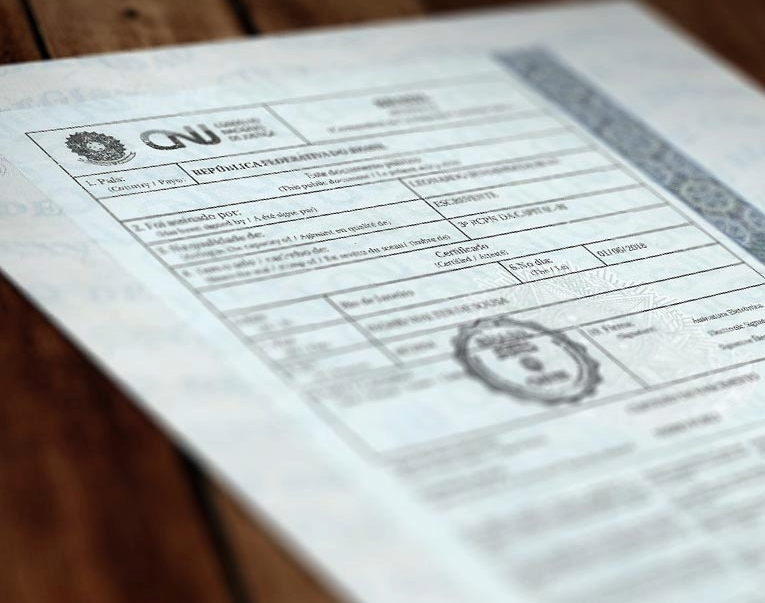
The Hague Apostille transformed the international validation of documents, eliminating bureaucratic steps that used to take months. Even so, many people still have questions about when they actually need to apostille original documents. Not every document requires an apostille, and understanding the differences saves time and money. This guide explains when the apostille is mandatory, which documents can be apostilled and the difference between apostilling originals and authenticated copies.
Key takeaways
- The apostille only works between countries that are parties to the Hague Convention
- Brazilian public documents can only be apostilled in Brazil, by notary offices (cartórios) authorized by Brazil’s National Council of Justice (CNJ)
- Private documents need signature notarization before the apostille so they carry public faith
- Authenticated copies can also be apostilled, and they work like originals for international purposes
- The apostille does not validate the content of the document; it only certifies the authenticity of the issuing authority’s signature
- Countries that are not parties to the convention require consular legalization, a more complex and time-consuming process that is still handled by Brazil’s Ministry of Foreign Affairs (Itamaraty)
The role of the Hague Apostille and how it simplifies what used to be complex
Before 2016, validating a Brazilian document for use abroad was a long and expensive process. First, you had to have the signature notarized at a notary office. Next, you took the document to the Ministry of Foreign Affairs for legalization. Then you presented the document at the consulate of the destination country. And finally, you could still face additional steps depending on local requirements.
This took months and involved travel, lines and considerable costs. As a result, many Brazilians gave up on international opportunities simply because of the bureaucratic complexity.
The Hague Convention, to which Brazil has been a party since 2016, simplified this scenario. Today, a single apostille issued by an authorized notary office replaces all of these steps. However, there are still many questions about the apostille: When do I actually need one? Does every document require an apostille? Can I apostille copies, or only originals?
In this article, we answer these questions to help you understand exactly when and how to apostille your documents.
What is an apostille and what is it for?
Certifying the origin, not the content
The Hague Apostille is a certificate issued on security paper that authenticates the origin of a public document. Essentially, it certifies that the signature, position and seal of the authority that issued the document are legitimate.
However, it is important to understand that the apostille does not validate the content of the document. It confirms that the authority that signed the document had the competence to do so. For example, if you apostille a birth certificate, the apostille certifies that the notary officer did in fact sign that document. It does not guarantee that the information on the certificate is correct.
Replacing consular legalization
Previously, consular legalization involved multiple authentication steps at different agencies. The apostille eliminated roughly four of these steps, making the process much faster and more affordable.
However, this simplification only works between countries that are parties to the Hague Convention. For non-member countries, you need to go through the traditional consular legalization process through the Ministry of Foreign Affairs.
When is the Hague Apostille mandatory?
Documents for use in member countries
You need to apostille Brazilian documents whenever you will present them in one of the more than 120 countries that are parties to the Hague Convention. These include all European Union countries, the United States, Canada, Australia, Japan, China, Argentina and Mexico.
It is also worth noting that without the apostille, these countries do not recognize the validity of Brazilian documents. Foreign authorities may reject your documents even if they meet all the other required standards.
Citizenship processes
Citizenship applications usually require apostilles on the birth, marriage and death certificates of every member of the line of descent. For example, Italian citizenship processes require you to apostille Brazilian documents before translating them.
Likewise, recognition of foreign judgments in Brazil requires an apostille on court documents issued abroad. So this process works both ways: Brazilian documents going abroad and foreign documents coming to Brazil.
International study and work
Diplomas and school transcripts must be apostilled to be accepted by foreign universities. Employment contracts and professional documents may also need an apostille to be validated by international companies.
In addition, regulated professions such as medicine, engineering and law generally require apostilled diplomas for professional recognition abroad. In these cases, you will need to go through validation processes, but the apostille is the mandatory first step.
Business and legal transactions
International contracts, powers of attorney for use abroad and corporate documents also often need an apostille. Tax clearance certificates and documents related to imports or exports may also require the Hague Apostille.
Purely commercial or customs documents generally do not need an apostille. However, we recommend checking with the institution that will receive the document to confirm the requirement.
Which documents can be apostilled?
Under the Hague Convention, the following can be apostilled:
Notary office documents: Birth, marriage and death certificates, plus certificates issued by notary offices, such as protest clearance certificates. Since these documents already carry public faith from the moment they are issued, they do not need additional signature notarization before the apostille.
Court documents: Judgments, certificates of finality, court permits and other documents issued by courts. Documents from the Public Prosecutor’s Office also fall into this category.
Administrative documents: Certificates issued by public bodies, such as the Federal Police criminal record certificate, diplomas registered with the Ministry of Education (MEC) and official documents from government ministries and departments.
Notarial acts: Deeds, notarized powers of attorney and declarations authenticated by notaries.
Private documents with signature notarization
Private contracts, declarations and other private documents can only be apostilled after the signatures are notarized at a notary office. This notarization gives the private document public faith, making it eligible for an apostille.
For example, if you have an employment contract signed by a private company, you first need to have the signatories’ signatures notarized at a notary office. Only then can you apostille the document.
Documents that cannot be apostilled
The Hague Convention clearly states that it does not apply to:
- Documents executed by diplomatic or consular agents
- Administrative documents dealing directly with commercial or customs operations
- Documents from non-member countries (in these cases, use consular legalization)
When to apostille the original document and when an authenticated copy is enough
Ideally, you should apostille the original document whenever possible. This removes any questions about authenticity and makes acceptance by foreign authorities smoother.
Fortunately, Brazilian law also allows authenticated copies to be apostilled. Here is how it works:
You take the original document to a notary office and request an authenticated copy. Next, that authenticated copy is taken to an authorized notary office for the apostille. Once this is done, the apostilled copy will have international validity similar to that of the apostilled original.
This option is especially useful when you need to present the same document to several institutions or countries.
Keep in mind that authenticating a copy has an additional cost, usually between R$5 and R$15 per page depending on the state. Be sure to factor this in when budgeting for the full process.
Step by step: how to apostille original documents
Step 1: Check whether the destination country is a party to the convention
First of all, confirm whether the country where you will present the document is a party to the Hague Convention. You can check the full list on the website of the National Council of Justice (CNJ).
If the country is not a party, you will need consular legalization through the Ministry of Foreign Affairs, not an apostille.
Step 2: Notarize signatures if necessary
Public documents issued by notary offices already carry public faith and can be apostilled directly. Private documents, however, require signature notarization before the apostille.
For example, school diplomas usually have three signatures: the dean, the secretary and the registrar. Each signature must be notarized separately, which adds costs.
Step 3: Find an authorized notary office
Not all notary offices can issue the Hague Apostille. Only those authorized by the CNJ have this authority. The full list of authorized notary offices is available on the CNJ website, organized by state and city.
You can also request an electronic apostille. This option can be faster and, depending on the state, even more affordable. Contact us and request yours by clicking here.
Step 4: Submit the documents and pay the fees
Take the original document (or authenticated copy) to the authorized notary office. The clerk will check whether the document can be apostilled and tell you the fees according to the state’s fee schedule.
After payment, the notary office will issue a receipt. The Hague Apostille is usually ready within 5 business days, but many notary offices can deliver it the same day or within 24 hours.
Step 5: Receive the apostilled document
The apostille can be issued in two ways:
Physical: A special seal or stamp is affixed directly to the original document or authenticated copy.
Electronic: The apostille is registered digitally in the CNJ system and can be verified via QR code. This format has the same legal validity as the physical one.
You can choose the most convenient format depending on the requirements of the destination country or institution.
How long is an apostille valid?
The apostille does not expire
The apostille itself has no expiration date. Once affixed to the document, the seal remains valid indefinitely.
However, this does not mean you can use apostilled documents indefinitely. What determines whether the document can still be used is the validity of the original document, not of the apostille.
If you apostille a criminal record certificate that is valid for 6 months, that period remains 6 months even after the apostille. The Hague Apostille does not renew or extend the original validity.
Likewise, Brazilian birth and marriage certificates are generally valid for 90 days for international purposes. So even if they are apostilled, you need to obtain new ones if that period runs out before you present them abroad.
Special cases and specific situations
If the destination country is not a party to the Hague Convention, you should not apostille the document. Instead, you need traditional consular legalization through the Ministry of Foreign Affairs.
This process is significantly slower and more expensive, and it can take weeks or months depending on the country. So plan well ahead.
Foreign documents for use in Brazil
Documents issued abroad can only be apostilled in the country of origin. For example, if you have a French birth certificate and need to use it in Brazil, it must be apostilled in France by the competent French authorities.
In addition, after the apostille in the country of origin, you will probably need a Brazilian sworn translation for the document to be accepted by Brazilian authorities.
How Zetta makes your apostille process easier
At Zetta, we offer a complete solution that combines the apostille and sworn translation in a single workflow. This means you don’t need to coordinate different providers or worry about doing things in the right order.
We arrange the apostille at authorized notary offices. Then our specialized sworn translators translate the apostilled documents.
By centralizing the apostille and translation with a single provider, you eliminate the risk of doing things in the wrong order. In addition, our translators know each country’s requirements in depth, so the translation of the apostilled document is accepted the first time.
As a result, you save valuable time and avoid rework costs caused by process errors.
Our team has specific experience with documents for citizenship processes, work and study visas, court recognition of judgments and diploma validation. So we tell you exactly which documents you need to apostille for each purpose.
People often apostille unnecessary documents for lack of proper guidance. Our advice helps you avoid these extra costs by focusing only on what is essential.